

When Clutter Feels Like Failure

If you’re like me, there’s a moment that tends to arrive soon after Christmas morning. The wrapping paper has been cleared, but not entirely. New toys sit in messy piles pretending to be organized by recipient. And the house feels chaotic, almost like it’s screaming at me.
By now, this moment is predictable. About thirty minutes after all the presents are open, I feel overwhelmed by how much we have, and how much more we just added. I feel an urge to go through every nook and cranny of the house and launch a multi-day decluttering operation. I start replaying the familiar story: we bought too much (why did we do that?), the house is a mess, I should have managed this better.
It’s not just annoyance. It’s shame.
Shame about the clutter. Shame that we overdid it this year with presents. Shame at the clear evidence that I’ve never quite figured out how to keep a calm, tidy house.
Lately I’ve been rereading some classic psychology books, Alfred Adler in particular, and I found myself wondering whether what was distressing me wasn’t the clutter at all. What if it was the expectation underneath it? What if the mess was simply where an expectation I had for myself became visible?
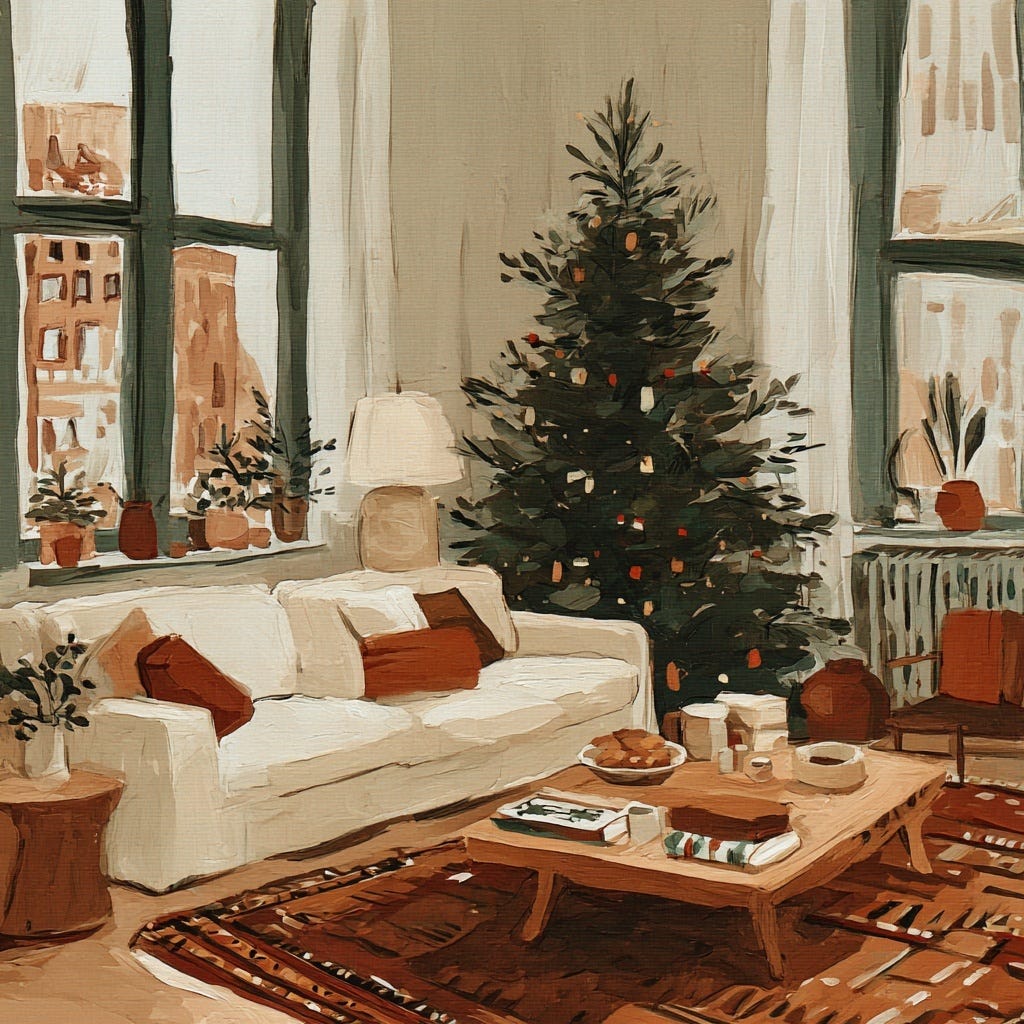
When I think back to Christmases as a kid, I remember the same post-morning overflow. Wrapping paper stuffed into bags. New toys scattered across the sunroom. Each of us with our own pile. But it didn’t feel like failure. It felt like abundance.
I loved those piles. They held projects for days: new journals to write in, books to start, lingering in the sense that there was time to unfold into whatever had just arrived.
Maybe my parents felt differently. But from my vantage point, the mess wasn’t a problem to solve. It was adventure. Who could complain about a pile of new projects and toys?
Somewhere between then and now, I learned to see the same scene as proof that I was lacking. I began holding myself to an internal rule that sounded something like: If I were doing this right, my home wouldn’t look like this. Disorder became a personal verdict. A busy house became a sign of not keeping up. With three busy kids, this reminder shows up daily, and over time it’s become one of my biggest sources of stress.
The days right after Christmas seem to amplify this. The house fills up because life is full, but fullness often starts to feel like failure.
What strikes me is how rarely we question the expectation itself. The expectation that a well-lived life should still look composed, especially during seasons that are inherently chaotic. That love, play, and generosity should arrive neatly, without residue. That if things spill over, it must mean we’re doing something wrong rather than exactly what we hoped to be doing.
That’s a lot to ask, especially in households with children and work pulling in every direction.
What often sets me off after Christmas isn’t the mess. It’s the story and self-judgment I attach to it, the sense that I’m failing some invisible standard I didn’t even realize I signed up for.
Once I can see the story I’ve been telling myself more clearly, it starts to loosen its grip. The scene itself begins to read differently. The same piles that once felt like evidence of failure start to look more like the aftermath of long days of play, projects left midstream, reminders that these moments were meant to be lingered in and savored, not immediately put away.
This isn’t an argument against tidiness. I genuinely love calm, beautiful spaces. I notice how my body settles when things are put away and the visual noise quiets down. But I’m becoming more aware that how we move toward order, and what we’re really trying to restore, matters.
And there’s a difference between restoring order from care and doing it from self-critique: between tending to a home in service of the life you’re trying to live and trying to prove something about yourself through it.
Eventually, things get put away. They always do. What I’m more interested in now is the moment before that happens, the pause where I notice the familiar discomfort and try not to immediately believe the story that I’m failing in some way.
Lately, when the house fills up again with art projects, half-finished creations, and toys spread across the floor, I’m practicing staying with that feeling a little longer. Not rushing to fix it. Not turning it into evidence that I’ve fallen behind.
Sometimes, if I slow down enough, I start to see the mess differently. Less like disorder, more like evidence of comfort and ease. A house that’s been used. A home where people felt free enough to belong, free enough to share half‑finished creations, unfolding ideas, and imaginations still at work.
That shift isn’t dramatic, and it doesn’t happen every time. But it feels like a more honest and sustainable place to stand, somewhere between wanting a beautiful home and recognizing happiness as it’s happening.