What the Wiser Self Does Differently
What it sounds like when the steadier voice gets to lead

This is Part 4 of a four-part series on the Reactive Self and the Wiser Self.
Part 1 — The Voice That Runs Your Life
Part 2 — Six Obstacles to Hearing Your Wiser Self
Part 3 — How to Reconnect with Your Wiser Self
Part 4 — What the Wiser Self Does Differently ← you are here
Part 3 walked through the practice. This part is what it actually looks like in a kitchen on a Tuesday night.
If you’re new here: we all carry two voices. The Reactive Self is fast, fear-driven, and organized around what might go wrong. The Wiser Self is steadier, connected to what we actually want and who we want to be. This essay is what happens when the second one gets to lead.

She is standing in the kitchen when her partner says something that lands wrong.
He is not trying to hurt her. She knows that. The comment (one sentence, offhand, in response to something she had brought up hoping for a different answer) is the kind of thing that in a different week, a different mood, she might not have registered in the same way. But today it triggered something.
She starts chopping the onion.
By the time she finishes with the onion, the case is already being built. The thing he said is no longer just a thing he said. It is connected to a comment she logged without realizing last month. Connected to a pattern she has been tracking in the background for longer than she’d be willing to admit. Connected to a deeper fear she hasn’t let herself name out loud. By the time she starts on the the sauce, she’s not in the kitchen anymore. She is in a courtroom, and he is on trial, and the evidence has been gathering for years.
She knows she is doing this. That is the strange part. She can watch the case assembling and still cannot quite stop it.
This is the terrain the Wiser Self is asked to work in. Not a convenient moment. A kitchen on a Tuesday with dinner still to make and kids who need things and something that landed wrong and hasn’t been processed yet. Life doesn’t stop. Most people don’t either. They push it below the surface and keep moving, which works, in the short term, until the thing they pushed down finds another way out.
The practice doesn’t need a convenient moment. Just a noticed one.
She notices the case being built. That is the first move.
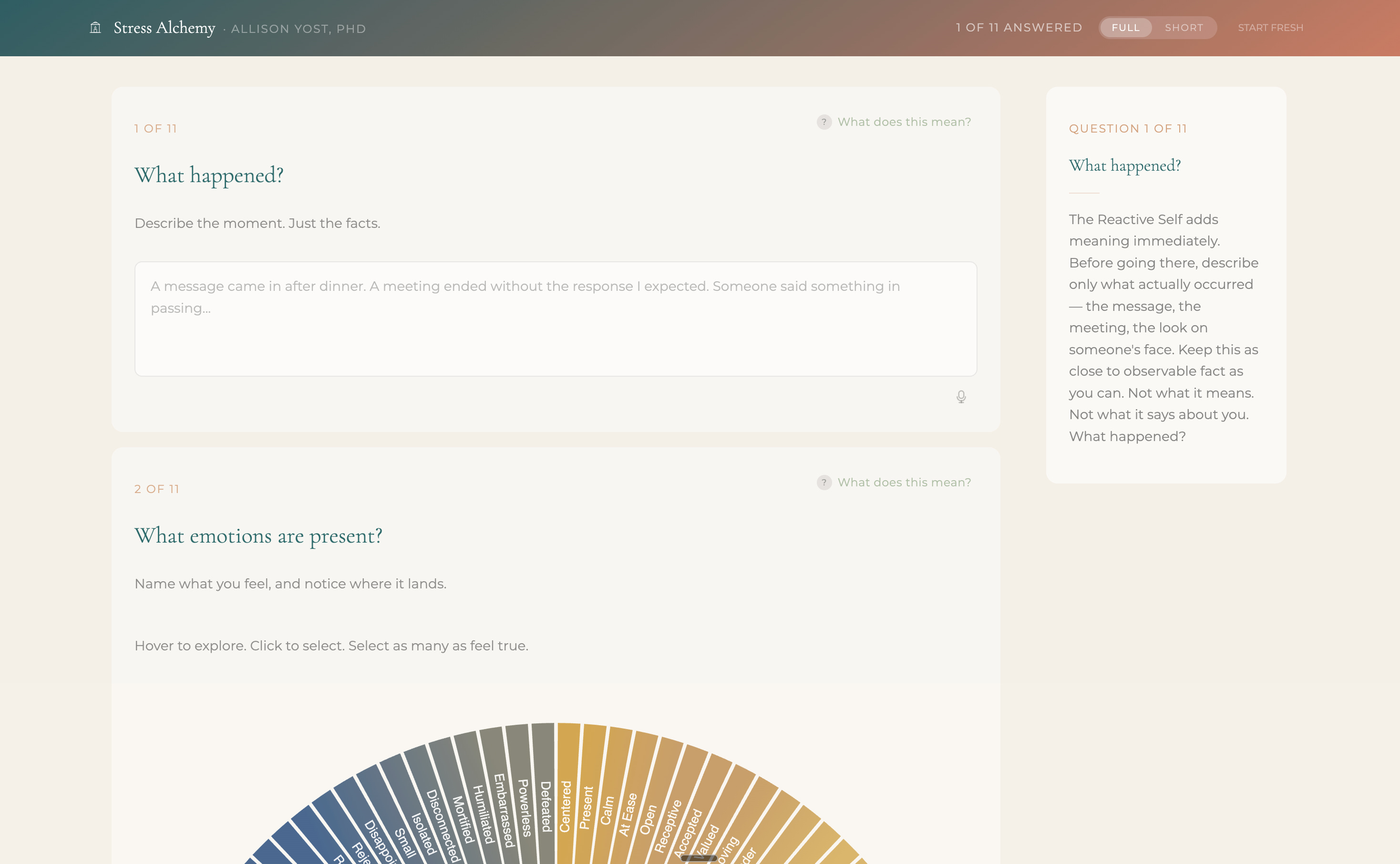
What am I feeling right now, and where is it landing in my body?
Hurt, mostly. And underneath that, something she might call embarrassment if she let herself look at it directly. Her chest is tight. Her jaw has clenched. There is a hot feeling at the back of her throat she recognizes. The feeling she gets right before she says something she will spend the rest of the week regretting. By the time she registers it, something sharper is already moving in. Frustration. And maybe the beginning edge of resentment.
The noticing does almost nothing on its own. Her body is still bracing. But for the first time since the comment landed, some part of her is observing it instead of being it.
She opens the refrigerator. Closes it without taking anything out.
What story am I telling myself?
That his comment wasn’t just a comment. That it connects to the one from last month, and to something that started before they even met. The feeling is familiar. It’s not always the same trigger, but the pattern is unmistakable: the way it moves faster than thought, floods the pause before she can form a question, arrives with the story already written. She can feel it wanting to become a verdict. The kind that makes her right and him wrong. She’s not there yet. But she can feel the pull.
What is my Reactive Self trying to protect?
That part comes faster than she expects. Her sense of mattering. That what she wants is worth asking for.
What am I afraid of?
Rejection. That this is actually saying something about not being good enough.
Naming the fear doesn’t make it hurt less. It actually makes it hurt more, at first, because it’s now in the room. But it does something else too: it stops being a judgment about him and starts being a piece of information about her.
She drinks a glass of water.
What actually happened?
She brought something up. Something she wanted. He said one sentence (not unkind, just honest) that he wasn’t sure, or wasn’t as excited as she was. That was it. One sentence, one Tuesday evening, two tired partners at the end of a long day.
What am I making it mean?
That maybe she asks for too much, or asks at the wrong time, or asks in a way that doesn’t quite land. That the problem, when she really gets into it, might be her.
Both of these cannot be entirely true. The first is a fact: one sentence, one Tuesday evening, two tired partners at the end of a long day. The second is a story, and stories are how we fill the gaps between facts and the beliefs we were already carrying. The fact was small. The belief was old. She had been waiting, without knowing it, for something to confirm it.
That is why it felt so true. Not because it was, but because it fit.
What do I actually want here?
This question lands differently than she expects. The first answer comes quickly: she wants him to be excited too. She wants his enthusiasm to meet hers.
But something underneath that stops her. She is not just wanting him to share this with her. She is waiting for his excitement to tell her that what she wants is worth wanting. That it is okay to want it in the first place. That she is good enough.
That is a different ask entirely. And it is not something he can actually give her.
The Wiser Self is not louder. It does not arrive with a flash. It just sounds, when she pauses long enough to hear it, like something calm and clear underneath all the noise.
It is okay to want this.
She thinks about what is still true. He has shown up in a hundred ways she takes for granted on a Tuesday like this. He is the person making her coffee tomorrow morning whether or not this conversation goes the way she hopes. He is the person who noticed, the last time she talked herself into wanting less to make it easier, and gently asked: is that actually what you want?
She thinks about what she was actually doing. She’s not asking for something unreasonable, she’s waiting for his enthusiasm to give her permission to want it. Those are not the same thing, and she has been treating them like the same thing.
She thinks about what is in her control. She cannot make him want this the way she wants it. She cannot guarantee his response. What she can do is say what she actually wants, without shrinking it first.
She takes a breath.
“I still want to do this. I know you’re not as excited, but it matters to me. Can we figure it out?”
The Wiser Self did not make the hurt disappear. What it did was keep her connected to herself: to what she actually wants, to what matters, to who she is when fear isn’t running the show.
From there, the lens widens. The Reactive Self narrows the world to the threat: what might go wrong, what she might lose, how to make the discomfort stop. Shrinking, fixing, controlling: all of them are responses to a world that feels too dangerous to want things in. The Wiser Self opens it back up. She is no longer armoring up forthe moment. She is moving toward something.
That is the shift the Wiser Self unlocks. Not from hard to easy. From reactive to creative. From managing what she fears to building what she wants.
She was still bracing when she said it. The case was still half-assembled. The hurt had not left the room. What changed was the direction she was moving: not away from what she feared, but toward what she actually wanted.
It works the same way at work, when an email lands wrong and the Reactive Self starts drafting the reply that protects your standing instead of the one that tells the truth. The Wiser Self asks: what is the actual information here, separate from the panic it is stirring up? And then moves toward something: a sentence that names the real thing, without the apology spiral and without the defensiveness.
It works the same way on the morning you were sharper than you meant to be with your kid, and the Reactive Self is already turning it into a verdict on your entire parenthood. The Wiser Self does not need you to be a perfect parent. It knows that losing your footing is not the same as failing, and that the relationship is not built in the not-falling: it is built in the going back. So you go back in. I’m sorry. That was not your fault.
It works the same way when the role you have built no longer fits, and the question is no longer whether you can do it but whether you still want to. The Reactive Self is doing its job, keeping you safe in the familiar. The Wiser Self does not demand you quit tomorrow. It just tells the truth: the fact that the old path is familiar does not mean it is still yours. You do not have to know the whole path to take the next honest step.
The work-version, the parenting-version, the career-version — they are not different practices. They are the same practice meeting different terrain. In each one, the choice is the same: defend against what you fear, or move toward what you want.
When enough Calm, Clarity, and Connection come back online, the questions change.
The Reactive Self was asking: How do I make this stop? What will they think of me? Who is causing this feeling?
What the Wiser Self helps you ask instead: What actually happened? What am I making it mean? What do I really want? What is still true? What is in my control? What is one honest next step?
The voice is different in texture. It does not say everything is fine when everything is not fine. It says this is hard, and I can meet it. It does not say I’m failing. It says there is something here I can learn from. It does not say I have no choice. It says I may not like the options, but I still have agency.
As Viktor Frankl wrote, in the space between stimulus and response lies our freedom and our growth. That space is where the Wiser Self lives. The work is not to force it open. The work is to create enough safety, clarity, and connection that another voice has room to enter.
Not a louder voice or one that promises everything will work out exactly as you want.
A steadier one.
There will still be messages that make your chest tighten. Feedback that finds the old wound. Mornings when you are sharper than you meant to be. Conversations that do not go how you hoped. Seasons when the life that once fit starts to feel too small. My own Reactive Self is still very much present, running the show more often than I would like to admit.
The point is not to become someone who never reacts. The point is to recognize the reaction sooner. To notice the Reactive Self and know it is not the only voice available.
If you want to practice this with something real in your own life (a hard message, a sharp comment, a season you cannot quite name), Stress Alchemy is the version I made for myself several years ago, and have used most weeks since.