
How Many Summers Left?
Life Math, and the difference between being told the years are short and feeling it

A few summers ago, we were trekking over the dune at the end of the walk from my in-laws’ house to the beach. I was pregnant with our third and fighting a raging case of heartburn, while my husband dragged an overflowing wagon full of chairs, umbrellas, toys, and towels, our three- and five-year-old running ahead of us. A family with teenagers passed us coming off the beach, walking the opposite direction. “Enjoy it,” they said in passing. “It goes by fast.”

We heard versions of this constantly in those years, “the days are long but the years are short,” presumably in response to the dark circles under our eyes and our thinly veiled overwhelm. Parents of grown children would urge us to enjoy it now.
It was as if these people wished they could have time traveled: told their younger selves this so that they had actually, truly understood it, to the point that they became more patient and present with these little people who will one day not be here with them in the same way.
This well-meaning (and honestly, accurate) advice was also frustrating. Because that life chapter IS hard. And exhausting. It can feel so overwhelming that it’s hard to be fully present the way you might be if you could travel back in time to this very day from a future where everything has changed. Instead, I felt guilty that I couldn’t magically become more present and “savor” each and every moment, especially the hard ones.
Around that same time, the coach I was working with suggested I create a life vision: what I wanted my life to look like in 1, 3, 5, 10, even 20 years. To anchor in what my reality might look like, I noted how old I would be at each milestone year, and then expanded that to include how old my kids and parents would be, too.
Though it wasn’t the point of the exercise, seeing all those ages on a single page was eye-opening and poignant in a way I wasn’t expecting.
Chip and Dan Heath have a name for this: “tripping over the truth.” In *The Power of Moments*, they describe how the insights that change us rarely happen through being told. They impact us when we’re allowed to collide with a fact ourselves — suddenly, in a way we can’t unsee. No matter how many times someone tells you something, sometimes you have to experience it firsthand before it rings true. For a decade, strangers have been telling us the years are short. A column of ages on a single page finally made me trip over the gravity of it.
The feeling reminded me of the movie *About Time*. On its surface, it’s a zany romantic comedy: the men in one family can travel back to any moment they’ve lived, and the main character uses the gift the way you’d expect, redoing awkward first dates and fixing bad days. But the movie sneaks up on you: as his life deepens, so do his reasons for going back: above all, time with his father. It’s his father who hands him a two-part formula for happiness: live each ordinary day like everyone else, with all the tensions and worries that keep us from really seeing it. Then travel back and live the same day again, this time noticing all the sweetness he’d rushed past. By the end, he’s gone a step further and stopped using the power entirely. In the film’s closing voiceover, he explains: “I just try to live every day as if I’ve deliberately come back to this one day, to enjoy it, as if it was the full final day of my extraordinary, ordinary life.”
I won’t be able to go back in time and relive a day from any chapter I want. But the awareness from this “life math” created that same kind of bittersweet savoring, without the guilt of the well-intentioned “the years are short” advice.
The research supports this. When you’re reminded that your time is finite (assuming you can get past the paralyzing existential dread), the awareness tends to loosen your attachment to external approval and material striving, and tune you in to deeper meaning and purpose. You start to see your life with more coherence: the wonderful times and the hard times become equally important in shaping who you are. And the distinction between being told and feeling it turns out to matter: studies find that abstract reminders that time is short tend to backfire, making people more defensive — doubling down on busyness, control, and distraction — while specific, personalized reflection is what produces the shift. Memento mori, as the Stoics would say, jolts you out of living on autopilot (which assumes almost infinite time) toward more intentional living: savoring experiences, investing in close relationships, aligning your day-to-day with what really matters.
As much as I resisted it, I of course got sucked back into the day-to-day drama of being an overwhelmed working mom of young kids. I struggled to be the best parent I could while also becoming consumed with proving my value at work, often at the expense of being present for my kids. Each year or so, I repeated the visioning exercise, and each time it helped me re-anchor on what really mattered and make decisions that would get me closer. But I finally hit a point where I realized incremental tweaks wouldn’t be enough to close the gap between how I was spending my time, how I was showing up for the ones I love most, and what I would be doing if I were living intentionally with the end in mind.
After my own version of the dark night of the soul, I decided to step down from my executive role and pitch one that would allow me to be more mentally, emotionally, and physically present at home, while creating enough space and openness for a new chapter to emerge. I thought about what my 90-year-old self would compassionately advise, aware of the finiteness not just of my own life, but of the season I’m in: young kids at home, my parents healthy, my husband and I still feeling young (aside from our knees).
I was so nervous about the conversation with my boss. I had catastrophized my way to the worst case: that asking would mean I’d need to resign. And I had to accept that as a possible outcome. I did it anyway. (To his credit, he couldn’t have been more understanding and supportive.)
When I got home, my older two kids, who knew I was going to ask because they had been feeling the impact acutely, excitedly asked me how it went and when it would start. They told everyone.
My first full month without travel, I couldn’t believe how much I would have missed. Swim meets. Pep rallies. Field trips. A Magnatile zoo built for every animal figure we own. A thousand ordinary moments that never make it onto a calendar, yet add up to an extraordinary life.
I often think about Bronnie Ware, a palliative care nurse who counseled thousands of people at the end of their lives and recorded their most common regrets. At the top of the list: “I wish I’d had the courage to live a life true to myself.” Right behind it: “I wish I hadn’t worked so hard.”
The truth is, we never really know how much time we have left in the chapter we’re in, with the people we love, in our own life.
My intention isn’t to make you feel guilty, like you have to optimize every minute of every day. In fact, the more you work to manage your time, to “maximize” what you have left, the more hollow life feels. But the more you confront the limitations of life head-on by embracing that your time is limited and making tough choices because of it, the more vivid, meaningful, and joyful your life becomes — what Oliver Burkeman calls the paradox of limitation.
You can’t do it all. That’s a painful realization. It’s also a liberating one.
When you trip over the truth that “this too shall pass” (and not just the hard moments but the amazing ones too) you get the chance to rethink what success means. You make decisions, big and small, based on what matters most, and you drink in the present moment a little more often.
As Burkeman writes in Four Thousand Weeks, there will be a last time for so many things we love — a last swim in the ocean, a last deep conversation with a certain friend, the last time you pick up your child — and usually there’s no way to know, while it’s happening, that it’s the last time.
To help keep this memento mori way of living, I created a tool I affectionately call Life Math.
Enter birth months and years for yourself and your loved ones (kids, parents, pets, friends) and you can see, in moments, the time you likely have left in your seasons of life together. It’s free and completely private: no signup, no data collected, everything stays in your browser.
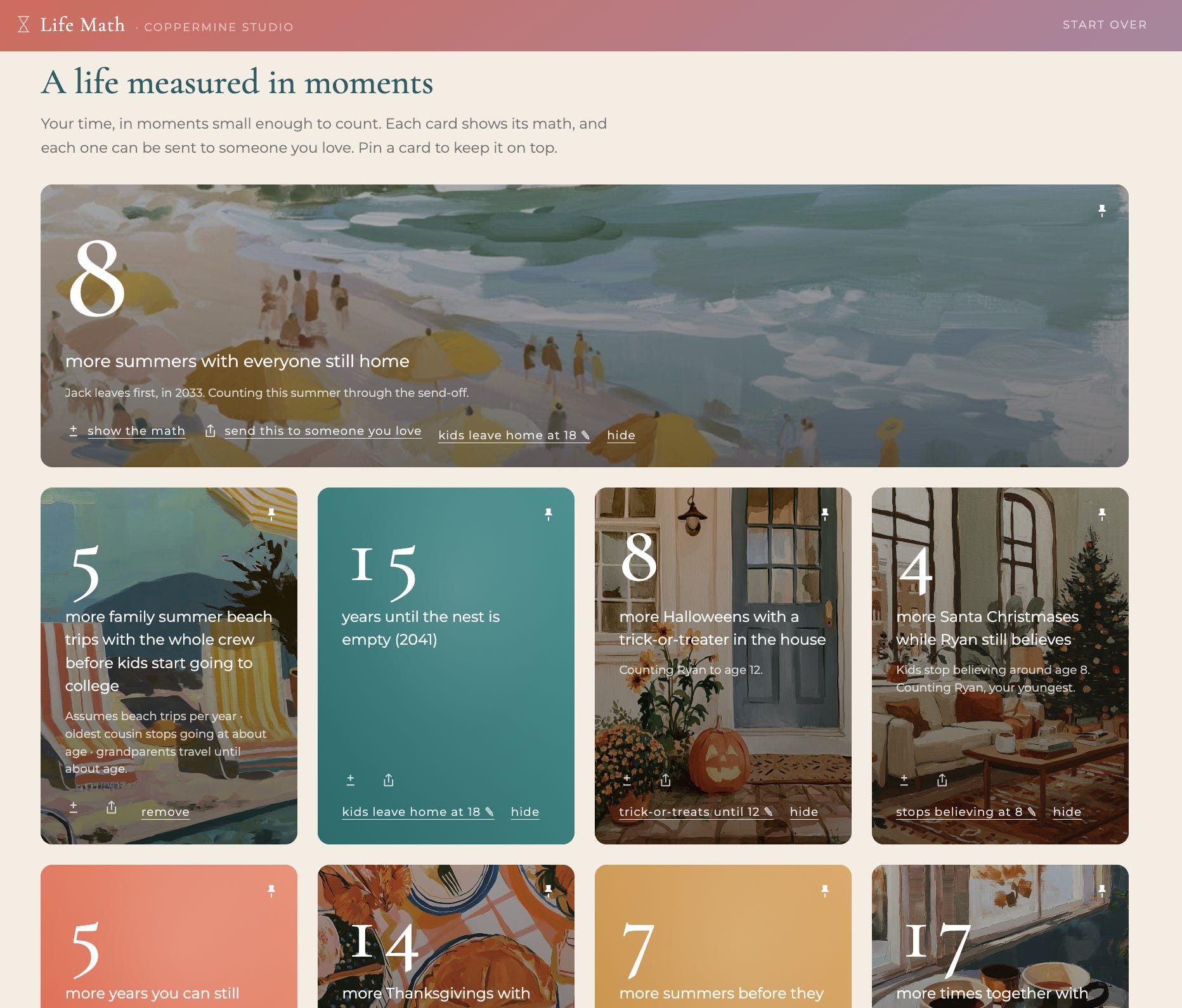
I ran my Life Math in the middle of one of our busiest seasons: summer swim team, with meets multiple times a week, practices every day, and always a sock hop, pancake breakfast, or themed dress-up day around the corner. It’s chaotic, but it’s brief, and as soon as it’s over, you start to miss it. And there it was: After this one, 8 more summers with all three kids at home.
Eight. Eight more summers of doing it all together: the early-morning meets, the sock hops, the pancake breakfasts. And then we’ll be getting our oldest ready to leave for college.
Since building it, I keep tripping over new truths. Maybe four more Christmases while we still have a Santa believer in the house. And if we’re lucky, 14 more with my parents at the table.
Then there’s the group of friends I grew up with: six of us, friends since we were little girls, most of them still in New England, me the farthest away. They manage to get together at least a few times a year, but I only make it back every few years. Even assuming long, healthy lives, that means I might only have 17 more times with them. We’re gathering this year for my milestone birthday. I’m so grateful, but I have tears in my eyes just realizing how few times we have left, unless I change something.
What’s helpful is truly feeling the brevity, not being told you should cherish it more. Because when you feel it, you have no choice but to notice things a little differently — and maybe do something about it.
Do your own Life Math. It’s free, private, and takes about two minutes.